About Us

My photo
Moshav Me'or Modiim, Israel
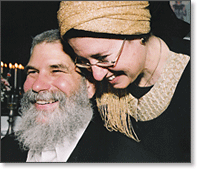
Rabbi Avraham Arieh and Rachel Trugman have over thirty years of experience in the field of Jewish education.

Tuesday, December 4, 2012

Chanukah and the Light of Creation

 It is explained in Kabbalah and Chassidut that the lights of Chanukah represent and ultimately reveal the hidden divine light of creation. This idea is based on many different reasons. Firstly, the chanukiah, the eight branched candelabra that we light on Chanukah, is clearly connected to the menorah in the Temple. We light eight nights to remember the lighting of the menorah in the Temple, and just as the menorah radiated divine light, so too do the lights of Chanukah.
     Yet, there are other allusions to the infinite divine light clothing itself in the finite light of the chanukiah. The Talmud quoted above relates that before the light of the first day was hidden away it was made available to Adam and Eve. It is further stated that they used it for thirty-six hours before they were exiled from the Garden of Eden.
     After Adam and Eve sinned they tried to hide from God, but He confronted them with one powerful word that has reverberated throughout the ages – eicha – where are you? This question is of course not in the physical sense, rather it is a much deeper existential challenge as to where have you gone; what have you done; who are you? The word eicha (איכה) significantly equals thirty-six, alluding to the divine light that would soon be hidden.
    This same word is the first word and the name in Hebrew of the book of Lamentations which we read on Tisha B’Av to the light of candles. In anticipation of the destruction of the Temple, the menorah was hidden away where it awaits discovery in the future. Here is an instance of divine light being revealed in the menorah, only to be subsequently hidden.
     During Chanukah we begin by lighting one light and each night add an additional one. Altogether we light thirty-six lights, a clear allusion to the infinite divine light of creation and a sign to us that it can be experienced even now.
     Chanukah is celebrated on the twenty-fifth day of the month of Kislev. The twenty-fifth word of the Torah is the first appearance of the word light, (“let there be light”). The word Kislev  כסלו ,can be divided to read כס-לו , which means “36 (לו ) are hidden (כס ).” The thirty-six hours the divine light shone for Adam is hidden in the thirty-six candles of the month of Kislev.
     The miraculous flask of oil that was used to light the menorah, was hidden away and was the only oil that had not been made ritually impure by the Greeks. The light of the menorah is first revealed and then hidden, while the light of Chanukah is first hidden and then revealed. In this sense, the lights of Chanukah are a revelation of the hidden light of the menorah, yet now residing in not just the Temple, but rather in every Jewish home.
     According to Jewish law the lights of Chanukah are meant to be lit publicly in order to advertise the miracle. It is the only Jewish ritual we are taught to do in such an open, revealed manner. The root of the word Chanukah is chinuch, which means “education.” Perhaps more than any other mitzvah, the lighting of lights on Chanukah represents the quintessential mission of the Jewish people – to be a “light unto the nations.” The light of Chanukah is not merely a physical light, rather it is a spiritual light that is meant to be shared and revealed to the entire world.
     There is a Jewish tradition that there are thirty-six hidden tzadikim, righteous people, in every generation, on whose merit the world exists (Sanhedrin 97a). A midrash relates that when God said “Let there be light,” this refers to the acts of the tzadikim” (Bereishit Rabbah 3:8). In every generation there must be a certain amount of the original light of creation in order to keep the world in existence. The hidden tzadikim with their good deeds keep this light from going out.
     We are further taught that there is a spark of a tzadik within each and every Jew, as it says “And your people are all tzadikim…” (Isaiah 60:21). The small flask of pure oil hidden away from the defilement of the Greeks represents the hidden spark of a tzadik within each Jewish soul, no matter how far away one may wander from his or her roots. This spark is ready and waiting to be ignited and revealed to the world.
     The clash of philosophies at the time of Chanukah was between a Greek world view based on cold logic and the superficialities of physical beauty and pleasure, and the Jewish world view that embraced not only logic, but a higher spiritual reality that is at times paradoxical and beyond human reason. The word for logic in Hebrew is הגיון, whose last three letters spell יון, Greece. It is very interesting to note that although we think of science as being the epitome of rationality and Greek logic, physics today is perplexedly counter-intuitive and is based on one mysterious paradox after another, especially in relation to light, as we will discuss further on.
     In Kabbalah and Chassidut we are taught that it is an especially auspicious time to meditate when gazing upon the lights of Chanukah. Although there are many different explanations as to the various symbolism of the light, they all revolve around perceiving in the various elements of the wick, the dark light around the wick, the body of the light, the glow radiating from the light, and the oil or the candle itself, varying levels of God’s revelation of light, as well as the light of the soul. One particular verse is used meditatively in this context: “The candle of God is the soul of man.”
    Along with the thirty-six lights of Chanukah, each night we light a shamash, an additional “servant” light, in as much as it is forbidden to use the lights for any direct benefit. Together there are forty-four lights. Rabbi Yitzchak Ginsburgh explains that in the discipline of gematria, Kabbalisitc numerology, which reveals deep, inner meaning according to numerical equivalencies, one may add one for a word, or in this case an additional one for the overall concept of the Chanukah lights. Altogether, forty-five represents all the lights of Chanukah, the same number as Adam, man, in the above verse. Meditating on the lights of Chanukah and integrating the unity of the opposites the lights represent  - physical and spiritual, infinite and finite, God and man - brings the heart and mind to great heights of awareness and a deep inner peace.
     When taking the forty-four actual lights and multiplying them by two, (their inner and outer dimensions,) it yields eighty-eight, which equals the word stream, נחל. The Arizal, the great Kabbalist of Safed, when reciting the blessing for lighting the lights would say “who has commanded us with His commandments and commanded us to light Chanukah light (להדליך נר חנוכה) in order that there be thirteen words (other versions have fourteen words; to light the lights of Chanukah) and that the first letters of the last three words would spell (not in order) נחל, stream. He taught that one should envision when lighting the lights a stream of pure divine light coming from above washing over ones self like a waterfall.
     The unity of water and light in this image reminds us of the word for heaven, שמים, being a combination of a shin, the letter of fire, and mayim, the word for water. In heaven the opposites of fire and water commingle in perfect harmony, which is not the case on earth. The lights of Chanukah unify the paradoxical opposites of light: infinite and finite, hidden and revealed, physical and spiritual.    
     Thirteen corresponds to the qualities of compassion God revealed to Moses. The Arizal sought in the lighting of the Chanukah candles to draw down God’s compassion and mercy into the world and upon the Jewish people like a waterfall of light. The first letters of the eighth quality of compassion, “Preserver of kindness for thousands of generations” (and the number of days of Chanukah,) also spells נחל, stream (נצר חסד לאלפים). Thirteen is significantly also the number of synonyms for light in the Torah.
     One last idea revealing an intrinsic paradox of the lights of Chanukah is the well known disagreement between the House of Hillel and the House of Shamai regarding the order of lighting the lights. Hillel taught we begin with one and add each night till reaching eight on the last night, while Shamai taught just the opposite, to begin with eight the first night and to end with one. Although we follow the opinion of Hillel we are taught regarding this and similar types of arguments throughout the Talmud that “These and these are the words of the Living God” (Gittin 6b; Eruvin 13b). This type of paradoxical logic where two diametrically opposed opinions, mutually exclusive, are both seen to be correct is a particular Jewish way of looking at the world.

Wednesday, October 10, 2012

Succot March of the Nations

 On Thursday October 4th the annual March of the Nations was held in Jerusalem. My wife and I went a few years ago and enjoyed it so much we went again this year.

The march is part of an annual effort by the Christian embassy in Jerusalem to bring supporters of Israel from around the world to Jerusalem each year on Succot. This idea is based on the haftorah read on the first day of Succot which declares that in the future after the final wars have been fought between Israel and the nations, those nations that remain will come up to Jerusalem every year on Succot. This year more than ten thousand people from sixty countries participated. Many of the marchers were dressed in their native attire and thousand waved colorful flags, blew shofars and proclaimed their love and support of Israel.

Sometimes the media portrays Israel as being alone and isolated in the world and there is some truth to this. Yet we should not forget that there are lovers of Israel in countries around the world who are prepared to go to great lengths to show that support. 

So enjoy these pictures which show the exuberance and excitement of the March.


Friday, September 14, 2012

Sweet Recipes for a Sweet New Year!


Rebbetzin Rachel's [Sweet] Recipes...


In line with a “Sweeten All the Judgments” theme for all my Rosh Hashanah cooking I start the meal with a slightly honeyed version of standard dips for challah. Using the traditional round challah with raisins, “what goes around comes around…” we turn the feast into a prayer form asking, begging Hashem with every bite to please make it a sweet year for the whole world.


Sweet Techina
Mix 1 C sesame paste with ½ C water add 3 T honey, 2T lemon juice, ½ t ground cumin, ¼ t salt. Mix thorougly adding water if needed to get a smooth sour cream like consistency.


Sweet Guacamole
It almost sounds oxymoronic to have sweet guacamole, but try this it really works!
Scoop out the pulp of 3 ripe avocados, add 2 T lemon juice & 2 T honey & a pinch of salt.
That’s the base for each dip. Now you can get playful by adding chopped dates, or apricots, red grapes, nectarines etc., limited only by your imagination. This year I’ll probably add pomegranate seeds because we have a bumper crop of that jewel - like seven species specialty of Israel on our trees.
The chunks of fruit will make it bumpy and lumpy, like the spicy standard guacamole eaten with corn chips while cheering for a favorite football team, like my favorites the Denver Broncos. They lost the super bowl several times but never gave up! Their fans painted the streets of the “Mile High City” bright orange. They came back again and again until they won.

As Shlomo Hamelech says in Proverbs “Seven times the righteous fall and still get up.”
Let me know which combo is your winner.


Wednesday, September 5, 2012

Last leg of our teaching tour!

This will be the last blog post from our amazing month-long teaching tour. Last post I left off in Vancouver. It was our first time visiting this beautiful city surrounded by water everywhere and majestic mountains. After our wonderful program with Chabad we were invited back the next night to the home of Rabbi and Rebbetzin Bitton for dinner. During that visit he shared how he had been a good friend and learning partner of Rabbi Gavriel Holzberg who was murdered along with his pregnant wife Rivki in Mumbai India 4 years ago. His center had recently dedicated a sefer Torah to their memory. He told how the shock had reverberated throughout the world of Chabad, especially the young shlichim around the globe and how it took a long time to integrate the events. Last week I wrote of my great esteem for the work Chabad does all over the world, sometimes at great cost - but this evening raised my esteem to a whole new level.

We left Vancouver for Chicago and the next day drove to South Bend, Indiana with my sister and brother-in-laws. Their daughter, (our niece) lives there with her husband and baby daughter. We did a full shabbaton with Carlebach davening, communal meals, divrei Torah, classes, discussions and singing. Saturday night we were invited to an impromptu music jam and played late into the night. Sunday morning I spoke and played music at a brunch, where the topic was once again The Mystical Power of Music. All in all everyone was very receptive and welcoming, a perfect way to end our teaching on this tour.

Next stop - home and a new year!!! May we all be blessed with the best one yet.

Wednesday, August 29, 2012

Beautiful Northwest Country


Continuing escapades as the Trugmans roam through the beautiful northwest country. We spent a beautiful Shabbat at sea. Somehow among 3,000 people aboard us 150 Yidden were able to pull off a peaceful, calm Shabbat. Davening was replete with singing, dancing, learning and of course kosher feasting... We disembarked in Victoria, British Columbia on Saturday night and bid farewell to a whole group of new friends whom with we shared the beauty of Alaska and God's handiwork. In Victoria we were hosted by a wonderful family who directed us towards the highlights of this absolutely charming city on Vancouver Island. We saw deer roaming freely in the city, went to the world famous Butchard Gardens where we marveled at the most gorgeous gardens, and visited the oldest China Town in Canada. But most important was our teaching at Chabad where people were wide open to hearing about the Mystical Power of Music. Many people who rarely come to synagogue filled the Chabad center.


The next day we took the ferry to Vancouver, a bustling city surrounded by water everywhere and majestic mountains. Once again we presented the Mystical Power of Music through Chabad. This time to a group of young professionals, including a nice number of Israelis. My appreciation and awe for Chabad has grown tremendously these last few years as we continue to work with Chabad literally all over the world. The absolute love, commitment and meseirut nefesh of the Chabad shluchim is a shining example of everything good and wholesome and genuine about Torah. We began the evening by blowing shofar and explored with them the powerful energy of music from the atom to the galaxies, from the mind to the heart.

Next stop Chicago and big Shabbaton in South Bend. Indiana!

Sunday, August 26, 2012

How great are your works Hashem!

Every morning we recite the following - "How great are your works Hashem, You have crafted them all with wisdom." The last week during our cruise to Alaska these words took on added meaning as we were privileged to see the grandeur of Alaska and Canada. There were so many highlights I will mention just a few of them. We saw a good number of glaciers, many from very close. Of course we were seeing only the end tip of them, some which stretched for 1,500 miles. To our amazement they had a beautiful blue tint, were mammoth and are constantly moving. For the first time I learned how much of the earths present geological makeup was formed by glaciers cutting themselves through mountains and forming the valleys and lakes around the world. These ice monoliths were truly awe inspiring. The mountains were majestic everywhere we looked and hundreds were still full of snow.


We saw pods of wales, a brown bear catching salmon, salmon running up stream by the thousands, a bald eagle, a spotted owl, and sea otters. We heard personal accounts of people who lived in small Alaskan towns like 'Juno, Skagway and Katchakan and contemplated life in a very far away place. In all these places the sun rarely shines and constant mist, clouds and rain form their reality. I was so happy when the sun finally came out as we approached Victoria, British Columbia where we disembarked for our next series of teachings.

While on board we had 3 minyans a day, daily teaching and an overabundance of great glatt kosher food.I lead Carlebach davening on Shabbat and in a very short time we befriended a whole lot of very, very, nice people. Although there were over 2,000 people on this mammoth floating hotel we were able with the cooperation of the boat line to live a normal Jewish life.

There is so much more to tell but we will let the pictures tell their story.

We are now in Victoria and will send more blog posts on the last leg of our trip.