About Us

My photo
Moshav Me'or Modiim, Israel
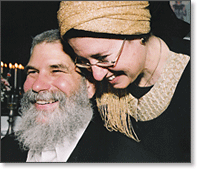
Rabbi Avraham Arieh and Rachel Trugman have over thirty years of experience in the field of Jewish education.
Showing posts with label ISrael. Show all posts

Sunday, April 1, 2012

The Fifteen Steps of the Hagadah

An excerpt from Seeds and Sparks by Rabbi Avraham Arieh Trugman


The Hagadah of Pesach and all the rituals and mitzvot of the night are ordered according to fifteen steps. These fifteen stages in which the Seder unfolds are also referred to as “signs.” Our Sages tell us that signs and symbols have great significance (Kritot 6a). For example, we begin the year on Rosh HaShanah night by eating all sorts of foods, each one symbolic of certain blessings we hope for at the beginning of a new year. The steps of the Seder likewise have great significance and symbolize the process of personal, national and world redemption. There is a custom of calling out the name of each step or  “sign” at the Seder as if announcing a lost object which needs to be reclaimed and redeemed (See The Chassidic Haggadah by Rabbi Eliyahu Touger).
     The fifteen steps of the Seder also relate to the fifteen physical steps in the Holy Temple, on which the Levites stood while singing praises to God. King David wrote fifteen “songs of ascent” to parallel the fifteen steps of the Levites in the Temple. The correspondence of the fifteen steps of the Seder and the fifteen steps of the Temple gives us the feeling of rising from one level to the next during the Seder, as if being carried on the wings of song to ever greater heavenly heights.
     Fifteen is the numerical value of the Hebrew letters yod and heh, the first two letters of the four~letter name of God, and a name of God in their own right. This name significantly appears in the book of Exodus in the story of Amalek, the arch enemy of the Jews, when God figuratively puts His hand on His throne and promises war with Amalek in every generation (Exodus 17:16). Rashi points out that only the first two letters of the name of God are written and the word for throne is also written missing a letter. This, Rashi explains, indicates that until Amalek, the embodiment of evil, is wiped out, God’s name and throne are, as it were, incomplete.
     The recital during the Seder of Pesach of the words: “ In every generation they rise up against us to destroy us…” reflects the same archetypal reality as expressed in the story of Amalek. The primordial energy of good versus evil, as expressed first in the story of Adam, Eve and the snake, and their final confrontation in the prophesies of the “end of days,” is very relevant to the energy surrounding Pesach and our present situation in Israel.
     There are “signs” all around us as Israel and the world confront the terrorist threat so prevalent today. But, as in every sign or dream, much goes after how we choose to interpret it. We are most certainly being challenged and are being spoken to by God through the events around us.
     As much as we need to react to evil and deal with the perpetrators, a more fundamental spiritual accounting is called for. We are told that the month long search and cleaning process for chametz, unleavened products,  preceding Pesach must be accompanied by the realization that physical chametz is but a reflection of the inner spiritual work we need to do to truly prepare for Pesach. Each person, community and all of Israel needs to look deeply within to see what we can do to rectify the present situation. There is certainly a need for a renewal of commitment to personal spiritual growth. To increase Torah learning and observance, to integrate sound Jewish morals and ethics, to increase our love of our fellow Jews and humanity, to give greater support to the land of Israel, and to recommit ourselves to Jewish collective responsibility. Let no one be oblivious to the fact that if Israel is seriously weakened (God forbid), every Jew in the world will be affected in a very negative way.
     The Ba’al Shem Tov taught that every Jew contains a spark of the Messiah deep within his soul and that the ultimate arrival of the Messiah depends on each and every person activating his greatest spiritual potential, thus creating a critical mass of redemptive energy. This then will be transformed into the figure we call the Messiah.
     In Egypt, when the slavery became so unbearable, we cried out in unison from the weight of our burdens and God heard and acted. Once again, we as a people need to feel the suffering and danger surrounding us and shake off our numbness and complacency in order to cry out to God to deliver us. There is no more auspicious time for us all to do this than on Pesach. We as a people have suffered enough - We Want Redemption Now!! 

Saturday, March 3, 2012

A Message to the Prime Minister of Israel


To the Honorable Prime Minister of Israel: Shalom u’vracha! We bless you with great success in your upcoming meeting with the President of the United States. The Alter Rebbe, the founder of the Chabad movement taught that we must “live with the times.” By this he meant that we should look into the weekly Torah portion and/or the closest upcoming holiday to receive insight into our own lives.

You are meeting with the President just a few days before Purim. The story of Purim happened in Persia which today is Iran. As is known Iran speaks about destroying Israel every chance it can, similar to the designs of Haman. In many ways the story of Purim is happening again in our own time and the genocidal tendencies are all too similar.

When Mordecai learns of Haman’s wicked designs he sends a message to Esther to go to the king and plead for the Jews. Esther tells him she cannot go to the king as she has not been invited. Mordecai answers: If you do not plead for the Jews salvation will come from another place but you will lose your chance to be the conduit of redemption…. Esther is convinced and of course salvation does come.

Mr. Prime Minister – the great weight of the Jewish people is upon your shoulders as you are probably most aware. We bless you with all our hearts to be able to say to the American President: We hope you will stand shoulder to shoulder with us but if not salvation will come from another place but you will be the biggest loser.

We bless you with strength and faith that salvation will come from another place, from the One who has always stood with us.

B’hatzlacha!!

Avraham Arieh Trugman and friends from Mevo Modiin

Sunday, December 18, 2011

Chanukah and the State of Israel


A question is often asked regarding the miracle of the Chanukah lights - why didn’t they wait the short time required till they could prepare pure oil for the menorah, rather than rushing to dedicate the Temple when there was only enough oil for one day. A similar question is why did Mattitiyahu launch the revolt against the Greeks in such a spontaneous manner, rather than first organizing his agenda and supporters.
     The answer to both questions are similar. Sometimes in life situations occur in such a way that only by acting immediately can one take advantage of the window of opportunity presenting itself in the present moment. In order to do this, one must divest himself of his own ego and previously perceived notions, and be totally open to the message God is sending through the situation. The more one nullifies the ego, the more clear the message comes through, giving wisdom and strength to act decisively in the moment, and thereby manifesting the full potential of God’s will. This is the intent of the statement of the Sages: “Treat His will as if it were your own will, so that He will treat your will as if it were His will. Nullify your will before His will, so that He will nullify the will of others before your will” (Pirkei Avot 2.4).
     A similar situation to the above examples at the time of Chanukah occurred a few years after World War II. As pressure increased in the world for a solution  for the Jewish refugees from the Holocaust, the United Nations in 1947 voted in favor of the partition plan, creating both Jewish and Arab states in Palestine. Despite this vote, anarchy and war continued unabated up to the date mandated for the plan to be implemented. As a result, strong forces were gathering momentum to postpone or rescind  the decision. Even among the Jews of Palestine and in the Diaspora great confusion, uncertainty and fear reigned.
     At this critical moment in Jewish history, David Ben Gurion, with the full force of his convictions, pressed for an immediate declaration of the birth of the State of Israel, despite the great odds pitted against its survival. He felt that if the present moment was postponed or squandered it may never come again. With little preparation and with no clear answers as to what would be the consequences of such a declaration, the fledging State of Israel was born.
     When celebrating Chanukah and lighting the lights it is important, even critical, to understand the relevance of the holiday for us today, to see how the cycles of Jewish history  not only repeat themselves, but afford us the opportunity to integrate, rectify and uplift the eternal spiritual and practical messages our holidays impart to us. In this way the words of the blessing: “…who did miracles for our fathers, in those days, in these times,”  is understood in Chassidic thought  to mean not just “in these times” - signifying this time of the year - but “in these times,” meaning our very time - right NOW!
     May we gain strength and clarity to grasp those special moments God gives us as individuals and as a people, in order to bring light to our souls, our homes, to all the Jewish people and the whole world.