About Us
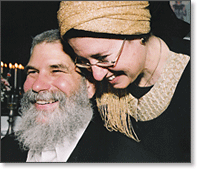
- TheTrugmans
- Moshav Me'or Modiim, Israel
- Rabbi Avraham Arieh and Rachel Trugman have over thirty years of experience in the field of Jewish education.
Wednesday, November 30, 2011


Wednesday, November 16, 2011
Wednesday, November 9, 2011
Tuesday, November 1, 2011
The Prayers of Cheshvan
(an excerpt from Orchard of Delights)
Cheshvan is the only Hebrew month
containing no holiday, commemorative event, or fast day. Following the month of
Tishrei, which has the major holidays of Rosh Hashanah, Yom Kippur,
Sukkot, and Shemini Atzeret, this lack is particularly noticeable. For this
reason some call it ‘Mar Cheshvan’ (Bitter Heshvan). Yet,
tradition teaches that in Messianic times, Heshvan will be “rewarded,” for the Third Temple
Rabbi
Shlomo Carlebach teaches that this month’s enormous spiritual potential is
created by the nature of our Heshvan prayers: prayers that reflect how we pray
when it seems as if our task has been completed, the verdict for the year
finalized. During Tishrei, when we are surrounded by the holiness of all the
holidays, it is easy to find the incentive and inspiration to pray. But what
happens when the holidays are over and we return to our ordinary routines? If
we fall back into our old ways as well, then the prayers and spiritual service
of Tishrei failed to touch us deeply enough. If we can actually bring to
fruition those changes we strived for and keep praying with the same commitment
and intensity, then we have the ability to transform a potentially bitter month
into an exalted one.
The
importance of not letting go of the achievements we have attained in Tishrei is
also reflected in the portion of Va’eira, which always occurs in the
middle of Cheshvan. In this portion, the first recorded prayer in the Torah
takes place as Abraham prays to save the wicked people of Sodom
Indeed,
even though God sent angels to save Lot before Abraham prayed, it was Abraham’s
prayers that saved the spark of Mashiach within Lot .
For Abraham wanted to believe that nothing was beyond redemption, nothing was
so broken that it could not be repaired, even the evil Sodom
Sunday, October 16, 2011
The Dance of White Fire
An excerpt from Orchard of Delights
After
the yearly Torah reading cycle is completed on the morning of Simchat Torah, we
immediately begin the cycle again by reading the beginning of Bereishit,
recounting the creation of the world. This practice connects the end of the Torah
with its beginning, as discussed in the previous section. This ceremonial
completion and immediate new beginning takes place following fourteen circuits
of joyous dancing and singing with the Torah: seven of which occur Simchat
Torah night and seven which occur on Simchat Torah morning. While the Torah
scroll is rolled from its end to its beginning (or a second Torah scroll is
readied for use), we find ourselves in a
very unique situation, a sort of spiritual no man’s land, suspended somewhere
between the end and the beginning. Although it only takes a few minutes to roll
or ready the Torah scroll for use, symbolically speaking, these moments reflect
an emotion that Simchat Torah is imbued with – a sense of anticipation. For
during the entire three week period since Rosh Hashanah we have been living in
suspended animation, waiting for the new year to finally show its true face.
Since this will finally happen on the day after Simchat Torah – at the end of
the holiday season – we are now ready to conclude the Torah and begin reading
it again.
The Midrash teaches that the letters of the Torah are like black fire engraved
on parchment that is analogous to white fire (Yalkut Shimoni, Yitro
280). To understand even a small part of the wisdom encoded in the black fire
takes a life time; the wisdom engraved in the white fire is at present beyond
human comprehension. On Simchat Torah we do not emphasize studying Torah.
Instead we dance on the white fire as if all is an open book waiting to be
revealed. This dancing connects us in a most profound way to the Torah as an
Orchard of Delights.
The sense of suspended animation we are in is symbolized by our dancing for
hours in circles with the Torah scrolls; this, in turn, recalls the verse from
Job (26:6): “He hangs the world on nothingness.” The numerical value of the
Hebrew letters in this phrase is 913, the same as the numerical value of the
Torah’s first word, “bereishit” (“in the beginning”). Dancing at the beginning
of a year full of promise, we are imbued with joy, trust, and faith in what the
new year will bring to us as individuals and as Jews. Although the script of
the Torah is written and God has rendered and sealed our judgments for the
upcoming year, Judaism firmly believes that in some sense the script is still
blank as we all continue to write our own script every day of the year.
Paradoxically, far from being closed books, our lives are open to change; we
still have the ability to determine much of what we will experience in the
upcoming year. This realization brings with it great joy and power, as we
symbolically roll the Torah back to Bereishit and acknowledge our
ability to choose to begin again.
The Talmud states that everything goes after the sealing (Berachot 12a).
The manner in which we conclude any journey in life affects how we will
remember it and how it will impact on our lives. Therefore, the Sages decided
that we should conclude the yearly reading of the Torah and the High Holiday
season with great joy and celebration, so that this energy would remain with us
and carry over into the new year.
At one of the most climatic moments during the Rosh Hashanah and Yom Kippur
prayers, we declare that repentance, prayer, and charity have the power to
nullify negative decrees. Immediately following the Ten Days of Repentance, the
joyous holidays of Sukkot and Simchat Torah teach us that joy also has the
power to nullify negative decrees, wiping the slate clean, and allowing a truly
new year to begin.
Tuesday, October 11, 2011
Rebbetzin Rachel's Recipes for a Super Sweet Sukkot!

 One of my neighbors told me her family didn’t like
Tzimmes - a traditional sweet dish served at this season. Tzimmes in Yiddish
means “a big deal” but this recipe is no big deal it’s actually easier than
pie. She asked me if I had a twist on the old classic. This recipe was such a
hit I just had to post it on our Ohr Chadash Blog!

Put a package of red turkey chunks (found in the
frozen meat section of your local store - in Hebrew הודו
אדום on top of some sliced
onions and fill the pot with water up to half the height of the meat. Sprinkle
on top some onion soup powder,sweet paprika and black pepper and let it steam
on a very low fire for about an hour. Then add chunks of those wonderful
vitamin A rich veggies such as pumpkin, carrots, butternut squash and sweet
potatoes and a generous handful of pitted prunes and there it is. Let it all
steam until tender. Add a tablespoon of honey a pinch of cinnamon a dash of
Allspice known locally as English pepper פלפל אנגלי (I guess the Middle Eastern pepper
temperature tolerance is fiery hot as compared to the mild mannered and not so
spicy Anglo). The sweet potatoes should break down and make delightful gravy;
the meat should be so tender it just falls apart.
Sweet Chag Sameach to ya’ll, LOL Rachel
Thursday, October 6, 2011
Yom Kippur and the Four Letter Name of God
As part of the religious decorations in many synagogues
around the world there is found the following verse from Psalms ( 16:8 ): “I
put God before me at all times.” In Kabbalah this verse is interpreted to mean
that the essential four letter name of God appears in the form and process of
every aspect of reality and is used as a model through which we understand the
Divine, as it manifests itself in all areas of life.
For example, the four letters of
God’s name - yod, heh, and vav, heh - form the words we use in
Hebrew for the passage of time: past (heh, yod, heh,) present (heh,
vav, heh) and future (yod, heh, yod, heh.) The aspect of time when
added to the three coordinates of space make up the four dimensions of
perceptible reality as taught by Einstein. Many other aspects of time, space
and material reality are based on the number four as well, such as the four
seasons (autumn, winter, spring and summer,) the four cardinal directions
(north, south, east and west), the four basic elements (fire, earth, water and
air), the four basic forces of the universe (gravity, electromagnetic, the
strong nuclear force and the weak nuclear force,) the four states of matter (solid,
liquid, gas and active combustion) the four aspects of creation (inanimate,
vegetable, animal and human) etc…
In addition to the physical universe, the
four letters of God’s name manifest throughout the spiritual worlds as well. In
Kabbalah we are taught that there are four worlds encompassing all levels of
created reality, from the spiritual to the physical: Atzilut - the world
of emanation; Briah - the world of creation; Yetzirah - the world
of formation and Assiyah - the world of action.
A beautiful allusion to the four
letters of God’s name is found in four major components of the holiday of Yom
Kippur. The yod, the first letter of God’s name, numerically equals ten,
corresponding to the date of Yom Kippur, the tenth of Tishrei, and the
culmination of the ten days of repentance. An additional correspondence relates
to Moses bringing down from Mt.
Sinai
The first heh of God’s name
numerically equals five, corresponding to the five prayer services of Yom
Kippur. We pray three prayer services daily and four times on Shabbat and
holidays. The only time of the year we pray five prayer services is on Yom
Kippur. This further relates to the five levels of soul (nefesh, ruach,
neshama, chaya and yechida,) of which the fifth one, yechida,
the super-conscious level of soul, is more accessible on Yom Kippur than any
other time of the year.
The third letter of God’s name, the
vav, numerically equals six, corresponding to the six divisions of the
Torah reading of the day. This is also an unique aspect of Yom Kippur, as it is
the only time of the year there is such a division. The number six in Kabbalah
relates to the six cardinal emotional characteristics within a person. On Yom
Kippur we attempt to rectify and seek forgiveness, especially for the mistakes
and shortcomings we have in these areas of our lives. The letter vav in
Kabbalah also symbolizes sexual energy. This is reflected by the fact that the
Torah reading of the afternoon service of Yom Kippur deals exclusively with
this topic.
The final letter in God’s four
letter name, the final heh, numerically equals five, corresponding to
the five prohibitions of the day: eating and drinking, bathing, anointing with
oil, wearing leather shoes and marital relations.
The above example is but one of an
almost infinite number of ways we can see the four letter name of God reflected
in creation. The more we learn of these correspondences, the more we come to
appreciate the deeper meaning of “I place God before me at all times.”
Subscribe to:
Posts (Atom)